FFL Types Explained: Type 01 vs. Type 07 – A Deep Dive for Your Firearms Business

If you're starting a firearms business, the first decision you'll make is which Federal Firearms License to apply for. For most entrepreneurs, it comes down to two options: the Type 01 (Dealer) or the Type 07 (Manufacturer). They look similar on the surface — both let you buy and sell guns — but the differences in what you're allowed to do, and what markets you can access, are significant.
This guide breaks down the privileges, limitations, costs, and SOT options for each license type so you can make the right call for where you want your business to go.
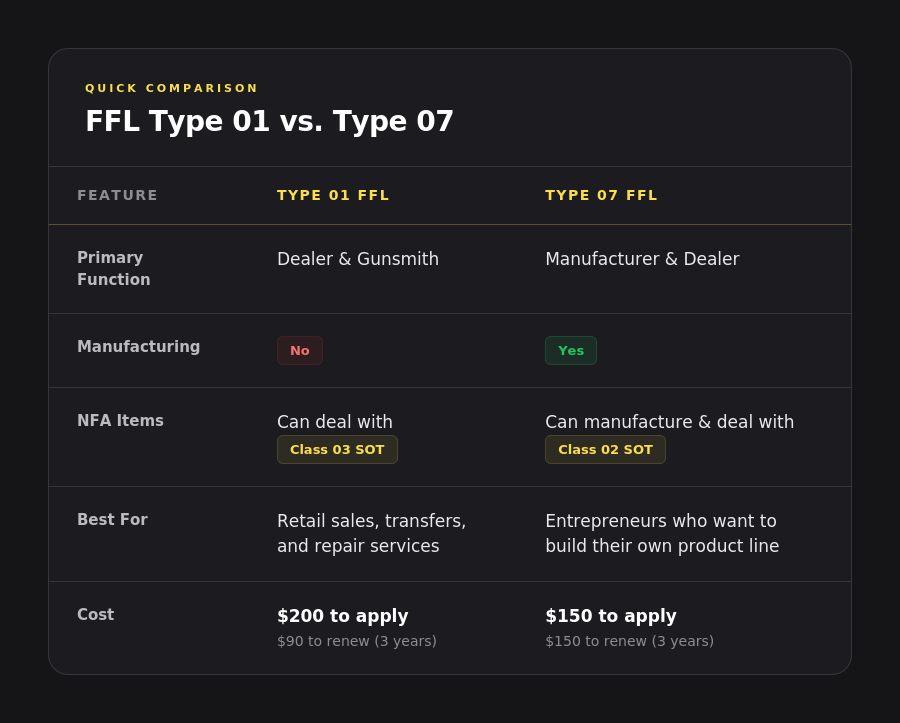
The quick comparison
Type 01 FFL: The retail dealer
The Type 01 is the most common FFL in the country. It's the license held by most local gun shops, pawn shops, and home-based dealers. If your business plan is to buy firearms from distributors and manufacturers and sell them to the public, this is the license you need.
What you can do with a Type 01
Buy and sell Title I firearms (handguns, rifles, shotguns, frames/receivers)
Receive firearms from other FFLs and the public
Conduct transfers for online purchases
Repair firearms
Acquire and sell curio and relic firearms
What you cannot do with a Type 01
Manufacture firearms for sale. This is the biggest limitation. Assembling a firearm from a stripped lower receiver and a parts kit — even using commercially available components — is considered manufacturing by the ATF. You cannot do this with a Type 01.
Manufacture ammunition for sale.
Manufacture NFA items. Even with a Class 03 SOT, you can only deal in NFA items, not make them.
Costs
The Type 01 FFL has a $200 application fee covering your first three years. Renewals are $90 every three years — the lowest renewal cost of any FFL type. If you add a Class 03 SOT to deal in NFA items, that's an additional $500/year (or $1,000 for businesses with gross receipts over $500,000).
Type 07 FFL: The manufacturer
The Type 07 includes everything the Type 01 offers, plus the right to manufacture firearms and ammunition. This is the license for builders, custom shops, and anyone who wants to make firearms — not just sell them.
What you can do with a Type 07
Everything a Type 01 can do (buy, sell, repair, transfer)
Manufacture firearms from scratch — design, machine, and build complete firearms
Assemble firearms from parts for sale — build custom AR-15s, precision rifles, or any other configuration from components
Manufacture ammunition for commercial sale
Apply serialization to Privately Made Firearms (PMFs) — required under the 2022 final rule
The NFA advantage
The real power of the Type 07 comes when you pair it with a Class 02 SOT (Special Occupational Taxpayer). With this combination, you can legally manufacture and deal in all types of NFA items:
Suppressors (silencers)
Short-Barreled Rifles (SBRs)
Short-Barreled Shotguns (SBSs)
Any Other Weapons (AOWs)
Machine guns (for law enforcement/military sales and dealer samples)
This is a significant revenue opportunity. The suppressor market alone has grown substantially, and being able to manufacture and sell them directly — rather than just dealing in other manufacturers' products — gives you both higher margins and the ability to build a brand.
Key distinction: A Type 01 with a Class 03 SOT can deal in NFA items (buy from manufacturers and sell to customers). A Type 07 with a Class 02 SOT can both manufacture and deal in NFA items. If you want to make your own suppressors, SBRs, or other NFA products, you need the Type 07 + Class 02 combination.
Costs
The Type 07 FFL has a $150 application fee (actually less than the Type 01) and a $150 renewal fee every three years. Adding a Class 02 SOT costs $500/year (or $1,000 for businesses with gross receipts over $500,000). The annual SOT payment is the biggest ongoing cost and is due each July.
Cost comparison: 3-year cycle
Type 01 (Retail only)
Year 1–3: $200 (application) = $67/year
Year 4–6: $90 (renewal) = $30/year
Type 01 + Class 03 SOT (Retail + NFA dealing)
Year 1: $200 + $500 = $700
Years 2–3: $500/year × 2 = $1,000
3-year total: $1,700 ($567/year)
Type 07 + Class 02 SOT (Manufacturing + NFA)
Year 1: $150 + $500 = $650
Years 2–3: $500/year × 2 = $1,000
3-year total: $1,650 ($550/year)
The Type 07 + Class 02 combination actually costs less than the Type 01 + Class 03 over a three-year cycle, while giving you dramatically more capability. For any FFL that plans to deal in NFA items, the Type 07 is the better value.
How to decide: Type 01 or Type 07?
Choose Type 01 if:
Your business is purely retail — buying from distributors and selling to customers
You run a pawn shop that takes firearms on pawn
You're a home-based dealer doing transfers and occasional sales
You have no interest in manufacturing, custom builds, or NFA items
You want the simplest, lowest-cost license to get started
Choose Type 07 if:
You want to build custom firearms (AR-15s, precision rifles, etc.) for sale
You want to manufacture suppressors or other NFA items
You're building a brand around your own product line
You want maximum flexibility — the Type 07 can do everything the Type 01 does and more
You see NFA items as a revenue opportunity (suppressors, SBRs, SBSs)
The bottom line: if there's any chance you'll want to manufacture firearms, build from parts, or enter the NFA market in the next few years, start with the Type 07. Upgrading from a Type 01 to a Type 07 later requires a new application, new fees, and potential inspection delays. It's easier and cheaper to start with the broader license.
What both types have in common
Regardless of which license you choose, both Type 01 and Type 07 FFLs share the same core compliance obligations:
ATF Form 4473 — Required for every firearm transfer to a non-licensee. See our step-by-step guide.
A&D Bound Book — Every firearm acquired and disposed of must be logged
NICS background checks — Required for all transfers
ATF inspections — Both types are subject to compliance inspections. See our FFL guide for audit preparation
Record retention — Form 4473s must be kept for the lifetime of your license. Digital storage eliminates the filing cabinet problem