What Are the Benefits of Digital 4473 eForm
ATF Form 4473 has been a paper document since 1968. For most of its history, there was no alternative — every FFL in the country processed the form the same way: hand the customer a clipboard, wait for them to fill it out with a pen, squint at their handwriting, call NICS, write the result on the form, and file the paper in a cabinet.
That changed in 2016 when the ATF issued Ruling 2016-2, which established the legal framework for completing Form 4473 entirely in a digital environment. Since then, a growing number of FFLs have switched from paper to electronic 4473 software — and the ones who have aren't going back.
This guide covers the practical, measurable benefits of switching to a digital 4473 eForm: what it actually changes in your daily operations, why it matters for ATF compliance, and what the experience looks like for both your staff and your customers.
What is a digital 4473 eForm?
A digital 4473 eForm is an electronic version of ATF Form 4473 that can be completed, signed, submitted, and stored entirely in a digital environment. Instead of paper and pen, the buyer fills out the form on a smartphone, tablet, kiosk, or computer. Instead of a wet signature, they sign electronically on the screen. Instead of filing the completed form in a cabinet, it's stored digitally — either printed for paper filing or retained in ATF-compliant cloud storage.
The ATF authorized this process under ATF Ruling 2016-2, which confirmed that FFLs may use electronic systems for the entire 4473 workflow as long as the system captures all required information, presents official ATF instructions to the buyer, and captures an electronic signature that meets the requirements of the E-SIGN Act.
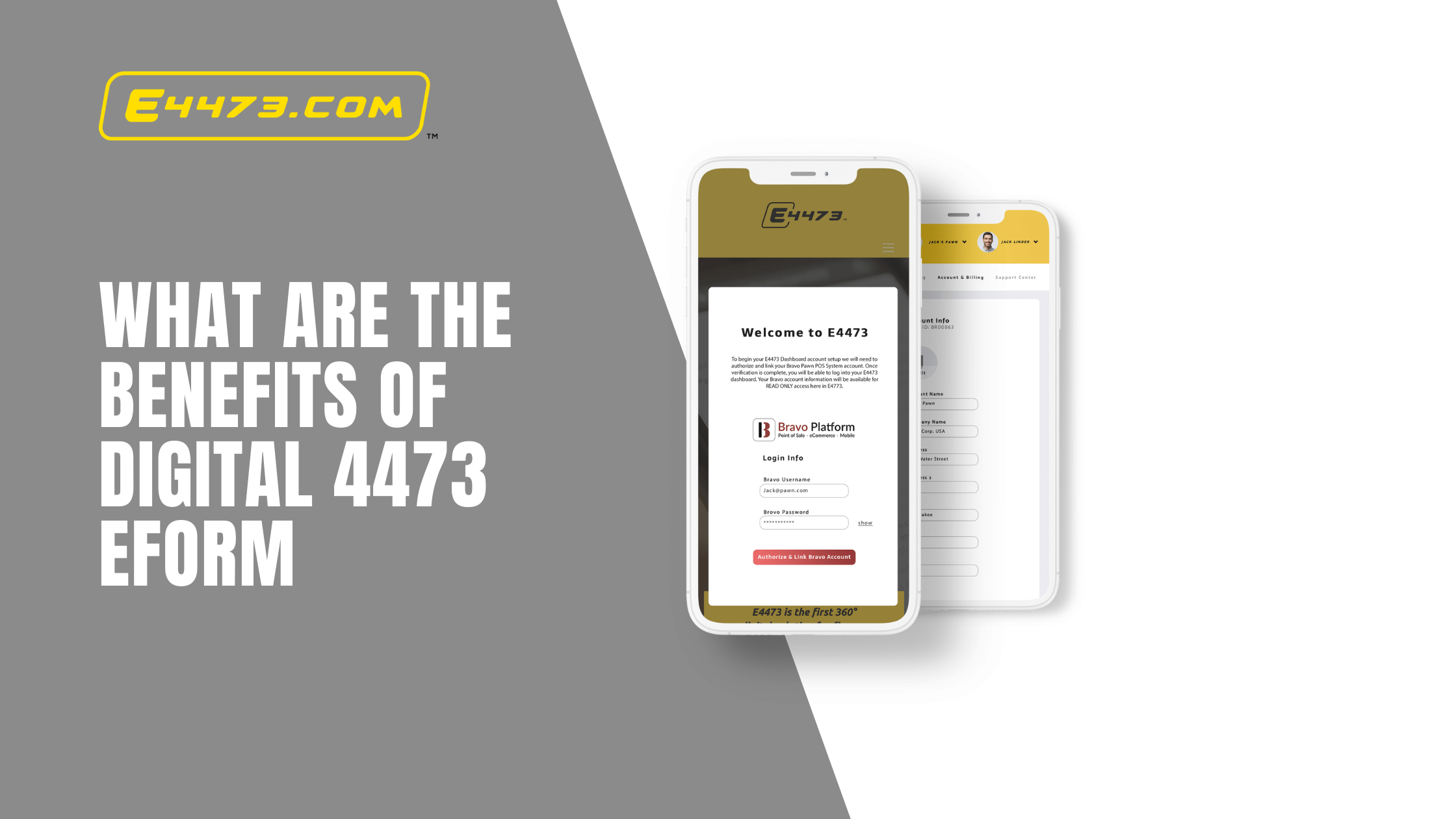
E4473 is electronic 4473 software built specifically for FFLs — from single-location gun shops to multi-store operations. It handles form completion, e-signatures, NICS background check submission, and digital storage in a single platform.
Benefit 1: Fewer errors, fewer ATF violations
This is the benefit that matters most — because Form 4473 errors are the single largest source of ATF violations cited during compliance inspections. Seven of the top ten violations come from mistakes on the 4473: incomplete fields, missing signatures, wrong dates, missing NICS Transaction Numbers, and incomplete firearm descriptions.
Paper forms make these errors inevitable. Customers skip questions they don't understand. They leave fields blank because they didn't see them. They write illegibly. They answer Question 21.a wrong because there's no one explaining what "actual transferee/buyer" means in the context of a gift purchase.
Digital 4473 software addresses every one of these failure points:
Required fields can't be skipped. The form won't submit until every required section is complete. No more blank county fields, missing dates of birth, or unsigned certifications.
Built-in ATF help language. Each question includes a help icon with the official ATF definitions and instructions — the same guidance that's printed on page 5 of the paper form, but accessible in real time at each question.
Smart logic. The form automatically skips questions that don't apply based on previous answers, preventing the most common mistakes where customers answer fields that aren't relevant to their transaction.
Validation alerts. The system flags answers that require additional review — like a "Yes" answer on a disqualifying question in Section B — before the form reaches the FFL for review.
The result is a cleaner, more complete form that holds up during ATF inspections. For a detailed breakdown of the most common 4473 errors, see our step-by-step guide to filling out Form 4473.
Benefit 2: Faster transactions
Paper 4473s are slow. The customer stands at the counter filling out a multi-page form with a pen while other customers wait. If they make an error, the FFL catches it during review, hands the form back, and the customer corrects it — adding more time. Then the FFL manually enters the buyer's information into the NICS E-Check portal, waits for the result, and writes it on the form.
Digital 4473 changes the workflow fundamentally:
Customers fill out the form on their own device
With E4473, the customer receives a text message link or scans a QR code and completes the form on their own smartphone or tablet — or on an in-store kiosk. They can start filling it out while they're browsing your store instead of waiting in line at the counter. By the time they're ready to purchase, the form may already be complete and waiting for your review.
Errors are caught in real time
Instead of finishing the entire form, handing it to the FFL, getting it handed back with corrections, and filling it out again — the digital form catches errors as the customer goes. Missing fields are flagged before they can move to the next section. The form that reaches your dashboard is already clean.
NICS submission is integrated
Instead of re-typing the customer's handwritten information into a separate NICS portal, your staff submits the background check directly from the completed digital form. The buyer's data auto-populates the NICS submission — no double entry, no transcription. The result appears in your dashboard alongside the form. For a deep dive on how this works, see our complete guide to NICS background checks.
The net effect
Transactions that took 15–25 minutes on paper can be completed in a fraction of the time. Your counter isn't bottlenecked by clipboard forms. Your staff spends less time reviewing and correcting errors and more time helping customers.
Benefit 3: No more illegible handwriting
This one is simple but significant. Illegible handwriting is one of the most common reasons Form 4473s get flagged during ATF inspections. If an IOI can't read a buyer's name, address, or date of birth, it's a compliance problem — even if the information was technically correct when the customer wrote it.
Digital forms eliminate handwriting entirely. Every field is typed, formatted, and legible. The buyer's name looks the same on the form as it does in the NICS submission as it does in your records 10 years from now. There's no ambiguity, no squinting, and no asking "is that a 3 or an 8?"
Benefit 4: E-signatures on every form
Every tier of E4473 includes electronic signatures. Customers sign on their device screen with a finger or on an optional Topaz signature pad. E-signatures are fully compliant with ATF Ruling 2016-2 and the E-SIGN Act.
This eliminates:
Printing forms for wet signatures — no paper, no ink, no printers jamming at the worst possible time
Scanning signed forms back into a system — a common half-digital workflow that adds steps without adding value
Missing signatures — one of the top ATF violations. With e-signatures, the form cannot be submitted without the buyer's and the FFL employee's signatures in place
Benefit 5: NICS integration eliminates double entry
We covered this above in the context of speed, but it deserves its own section because the compliance implications are just as important as the time savings.
With paper forms, the NICS submission is a separate process. The FFL reads the customer's handwritten information and types it into the NICS E-Check portal. This double entry introduces transcription errors — misspelled names, transposed digits in birth dates, wrong identification numbers. Those errors can:
Cause unnecessary NICS delays — a misspelled name may match a different person's record, triggering a false delay
Result in a false Proceed — if enough identifying information is entered incorrectly, NICS may clear a buyer who should have been denied
Create inconsistencies between the 4473 and the NICS record — which the ATF can flag during inspections
E4473's NICS integration eliminates all of this. The buyer's data flows directly from the completed digital form into the NICS submission. The NTN, date of contact, and response are recorded automatically. No re-typing, no transcription, no mismatched records.
Benefit 6: Customers can use their own device
One of the most practical benefits of digital 4473 — and one that's easy to overlook — is that customers can complete the form on their own phone.
With paper, the customer is anchored to your counter with a clipboard. They can't browse. They can't look at firearms. They're standing there, blocking the next customer, filling out a government form with a pen they probably don't want to touch.
With E4473, the customer receives a link via text message or scans a QR code and fills out the form on their own smartphone from anywhere in your store. They can do it while their spouse browses accessories. They can do it while sitting in your waiting area. They can do it standing next to the display case where the firearm they want is sitting.
This changes the customer experience meaningfully. The 4473 stops being the bottleneck of the transaction and starts happening in parallel with the rest of the shopping experience.
Benefit 7: Digital storage and audit readiness
Completed paper 4473 forms go into filing cabinets. Then boxes. Then a backroom. Then a storage unit. Over 20 years of retention — which is what the ATF requires — a moderately busy FFL accumulates thousands of forms that take up significant physical space and are vulnerable to fire, flood, theft, and simple misplacement.
E4473 Cloud Storage replaces all of that with encrypted digital archives. Every completed form is stored for up to 20 years in an unalterable format, organized for instant retrieval, and backed up daily to an on-site storage device as required by the ATF.
During an ATF inspection, your IOI can access the dedicated ATF Audit Portal from a designated workstation — searching, viewing, and printing any form they need in seconds. No pulling boxes, no flipping through filing cabinets, no "give me a minute to find that one."
For your own staff, Cloud Storage includes a self-audit mode so you can review your records the same way an IOI would — catch problems before they're found during an inspection.
For the full breakdown of ATF digital storage requirements, see our complete FFL guide.
Benefit 8: Better data security
A single Form 4473 contains some of the most sensitive personal information a customer can provide: full legal name, date of birth, Social Security Number, home address, government ID number, and answers to questions about criminal history, mental health, and drug use. On paper, all of that sits in an unlocked filing cabinet in your backroom.
Digital 4473 with E4473 protects that data with a 5-tier security protocol:
Authentication — only verified, authorized users can access the system
Encryption — all data is encrypted in transit and at rest
Monitoring — 24/7 monitoring for suspicious activity
Privacy — consumer personal identity protection with strict access controls
Backup — encrypted backups with daily on-site syncing
No one can walk into your backroom and thumb through digital records. No one can photograph a screen from across the counter. The data is protected by the same standards used to secure sensitive information across regulated industries.
Benefit 9: Automatic Form 3310 reporting
When a buyer purchases two or more handguns within five consecutive business days, the FFL must file ATF Form 3310.4 (Report of Multiple Sale or Other Disposition of Pistols and Revolvers). On paper, this requires filling out a separate form and submitting it manually.
E4473 automates this entirely. When a qualifying multiple-handgun transaction occurs, the 3310 report is generated automatically from the transaction data. No separate form, no manual filing, no chance of forgetting.
Benefit 10: Always current with ATF revisions
The ATF periodically revises Form 4473. The most recent revision was in August 2023, and it became mandatory in February 2024. FFLs using paper forms had to discard their old stock and order new forms — and any store that kept using the old version was in violation.
With E4473, form revisions are handled by the platform. When the ATF releases a new version, the development team updates the digital form to reflect the changes. You don't need to track revisions, order new forms, or worry about accidentally using an outdated version. The form your customers see is always current.
What the switch looks like in practice
For FFLs considering the move from paper to digital, the transition is simpler than most expect:
Choose your platform. Look for digital 4473 software that includes form completion, e-signatures, NICS integration, and cloud storage. E4473 includes all of these.
Set up your account. Most stores are live the same day. E4473 integrates natively with Bravo Point of Sale, so if you're already on Bravo, setup is minimal.
Train your staff. The system should be intuitive enough that employees learn it in a single session. E4473 includes on-demand training videos and step-by-step guides.
Notify the ATF (for digital storage). If you're adding Cloud Storage, submit written notification to your local ATF office 60 days before going paperless. This is required for digital storage only — you can start using the electronic form immediately.
Keep your existing paper records. Previously completed paper 4473s stay on your premises per 27 CFR 478.129. Digital storage applies to new forms going forward. You're not retroactively digitizing old forms — you're just stopping the pile from growing.
The bottom line
The benefits of digital 4473 aren't theoretical. They're measurable in fewer ATF violations, faster transaction times, eliminated double entry, encrypted data security, and records that can be retrieved in seconds instead of hours.
Paper forms worked for decades. But they come with problems that are built into the format itself — illegible handwriting, blank fields, manual NICS entry, physical storage, and slow retrieval. Every one of those problems is eliminated by going digital.
The question isn't whether digital 4473 is better. It's how long you want to keep dealing with the problems that paper creates.
See the difference for yourself: Schedule a free 15-minute demo and our team will walk you through the entire E4473 platform — digital form completion, NICS integration, e-signatures, cloud storage, and the ATF audit portal. No obligation, no pressure.